Follow us!
The HY4RES Final Conference took place on 27 October in Dublin, Ireland. Focusing on the deployment and replication of the hybrid renewable energy solutions developed and assessed throughout the project, the event provided a space for discussion around its key results.
Project partners and stakeholders from across the Atlantic Area had the opportunity to reflect on three years of research and practical application across various sectors in four countries: Portugal, Spain, Ireland and France.
HY4RES has developed software tools to support the design and management of hybrid renewable energy systems. One of these tools helps identify the most suitable combination of renewable energy technologies and storage solutions according to different needs and operating conditions. It has already delivered promising results, including a grid-connected scenario achieving 91.7% grid independence.
The project has also developed forecasting models to anticipate energy demand across its four pilot sectors: agriculture, aquaculture, ports, and communities. These models can predict hourly demand up to seven days ahead, with results showing high accuracy across the four pilot sites (R² above 97% and prediction errors below 9%).
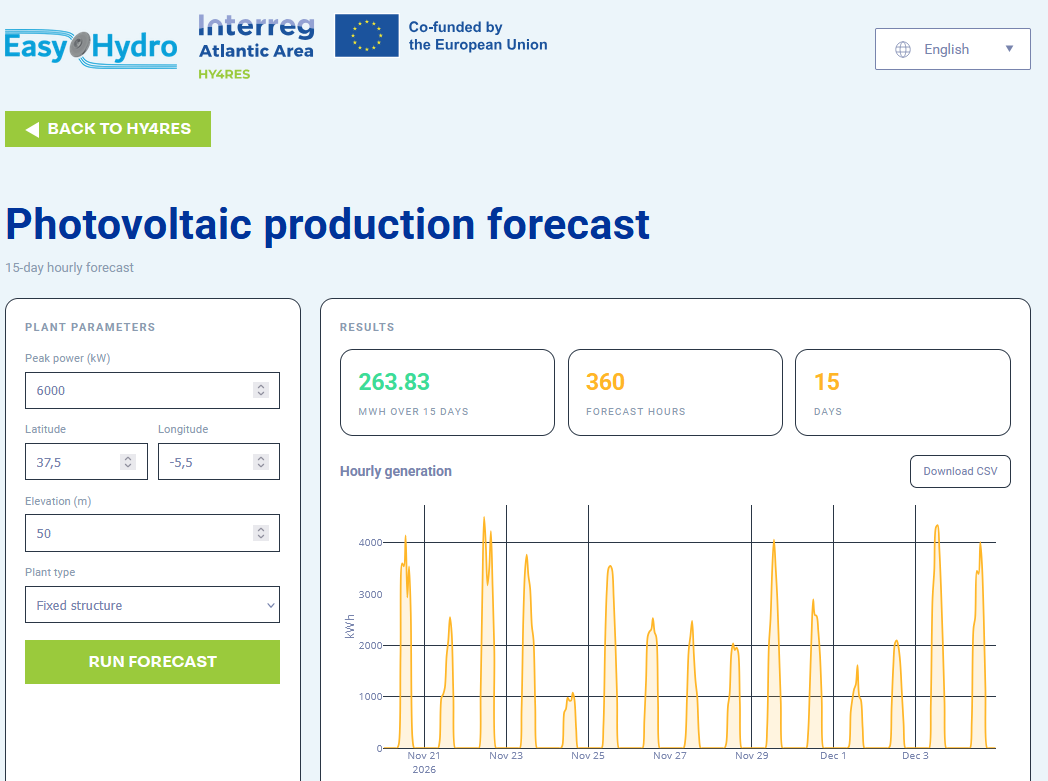
Alongside demand forecasting, HY4RES has developed tools to predict renewable energy production. They provide solar PV forecasts up to 15 days ahead, with hourly and daily resolution, and wind generation forecasts over the same period, with hourly resolution. These predictions can help energy system operators better anticipate renewable energy availability.
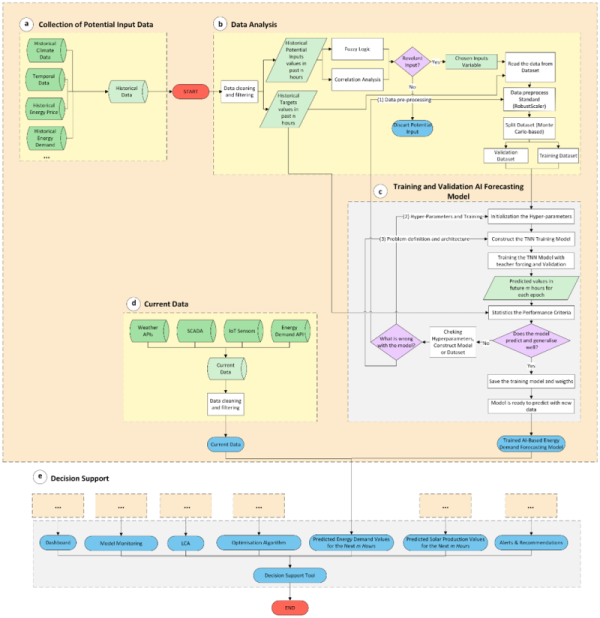
These developments feed into an intelligent energy management tool designed to recommend operating strategies that can:
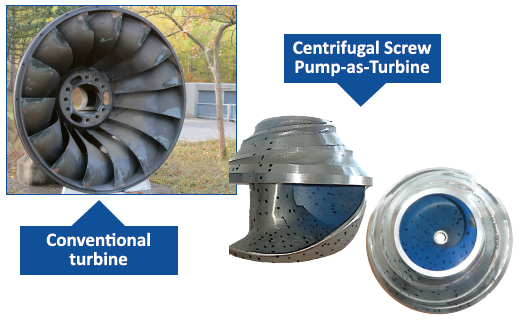
An important component of the technology development in HY4RES was the design and assessment of the ecologic, energy and economic performance of a fish-friendly pump-as-turbine² (PAT). Laboratory experiments and CFD³ (Computational Fluid Dynamics) helped refine the turbine’s design, balancing fish passage safety with electricity production.
During the research, design improvements increased the turbine efficiency from 22.8% to 50.97%, while also boosting power output.
A fish-friendliness assessment estimated fish survival at approximately 99%, with mortality below 1% and zero probability of strike. However, high vorticity was observed, and acceleration levels fell within the traditional-pump category rather than the fish-friendly-pump category. These findings highlighted the need for further validation through biological tests or fish-shaped models.
A next step for the development of this technology would be to test the initial Centrifugal Screw Pump-as-Turbine⁴ (CSPAT) design to power existing fish-passage facilities, while trialling the optimised design at pilot scale.
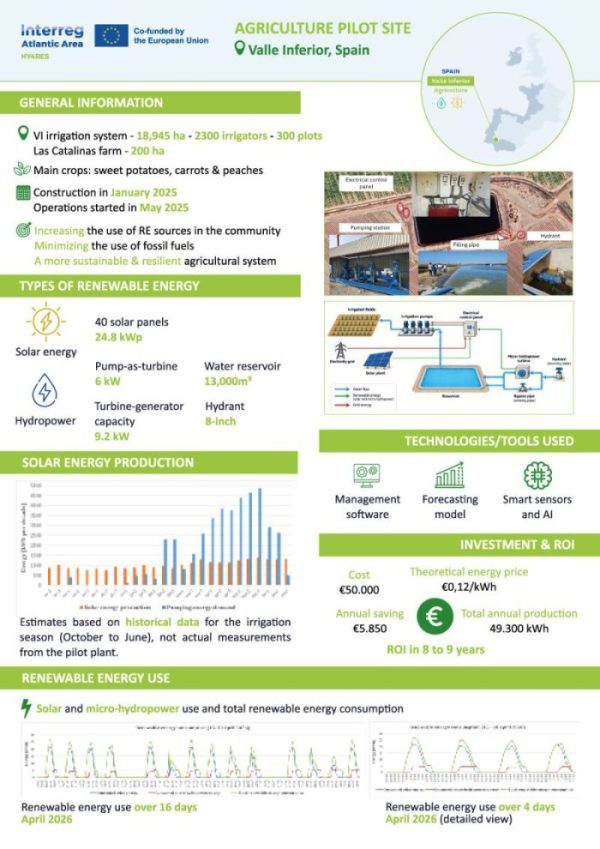
Located at Las Catalinas farm, in La Rinconada, Seville (Spain), within the Valle Inferior del Guadalquivir irrigation district, the HY4RES pilot dedicated to irrigation agriculture explores how hybrid renewable energy systems can contribute to more energy efficiency, lower costs and emissions for the farm.
The system combines a 40-panel solar photovoltaic system with a 9.2 kW hydropower turbine, recovering energy from excess water pressure within the irrigation network. This combination allows renewable electricity to be generated while supporting the farm’s pumping needs.
The pilot also explores how forecasting and intelligent energy management can help match renewable energy production with irrigation demand, reducing reliance on grid electricity and optimising energy use.
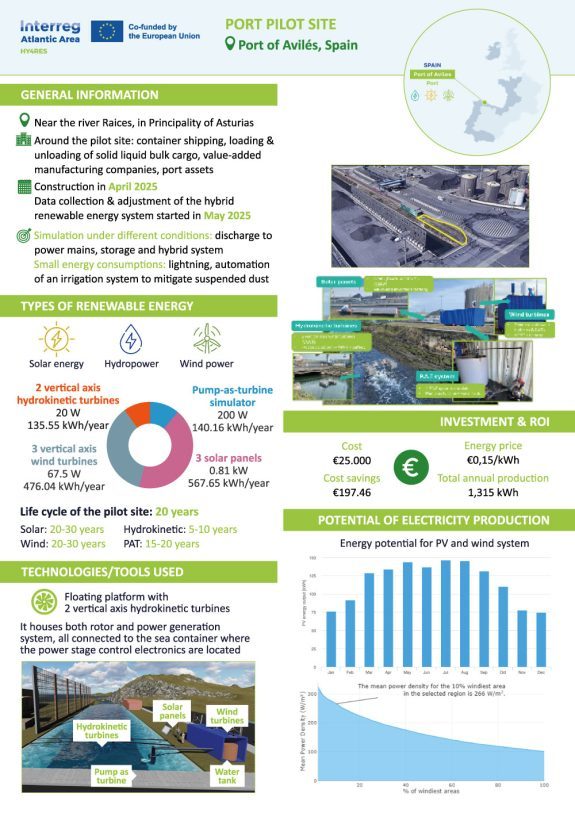
At the Port of Avilés, in northern Spain, HY4RES explores how locally generated renewable energy can help meet small energy needs within port environments, such as lighting and vehicle charging.
This pilot brings together three renewable energy sources: solar PV, wind, and hydrokinetic generation. It also includes an experimental hydraulic energy storage system using a pump-as-turbine, battery storage, and an energy monitoring platform. Housed in a 20-foot second-hand container, this hybrid energy hub is designed as a compact, modular, and transportable solution.
An intelligent energy management system coordinates energy generation, storage and consumption, supported by real-time monitoring through an IoE⁵ (Internet of Energy) architecture.
Evaluated under actual port conditions, the pilot demonstrated the technical feasibility of integrating multiple renewable technologies into a single system. Further work will focus on long-term validation, performance optimisation, and replication in other port environments.
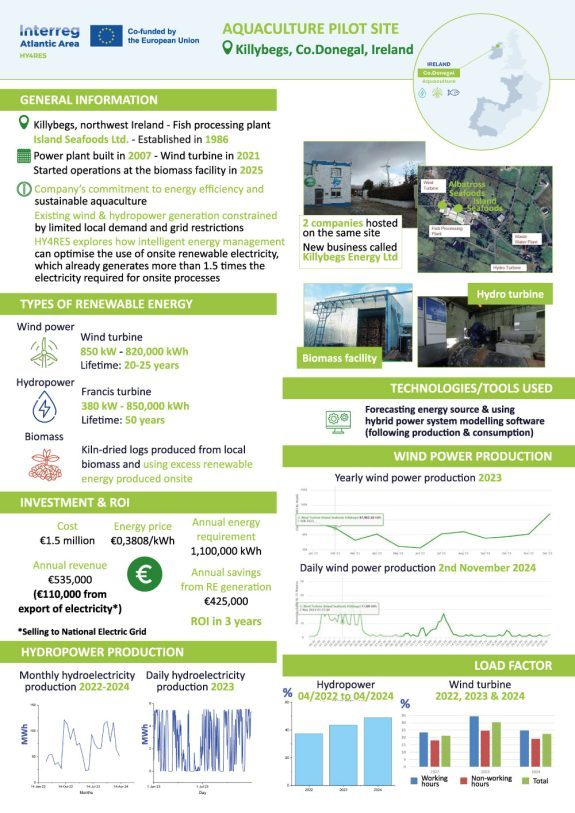
At Island Seafoods Ltd, a family-run seafood processing business in Killybegs, Ireland, HY4RES explores how to address grid limitation constraints leading to under-used renewable energy infrastructures. The approach was to develop a new facility to valorise excess energy and provide additional source of revenue for the company.
The site combines a hydropower plant with a rated capacity of 380 kW and an operating output of 200–240 kW, alongside a wind turbine with a capacity of approximately 750–850 kW. The surplus energy from the wind turbine is used to power a biomass drying facility, using locally sourced wood to produce value-added products such as kiln-dried logs and materials for wood pellets.
The production of new marketable products from this surplus energy has permitted to create new business opportunities and led to the creation of Killybegs Energy Ltd.
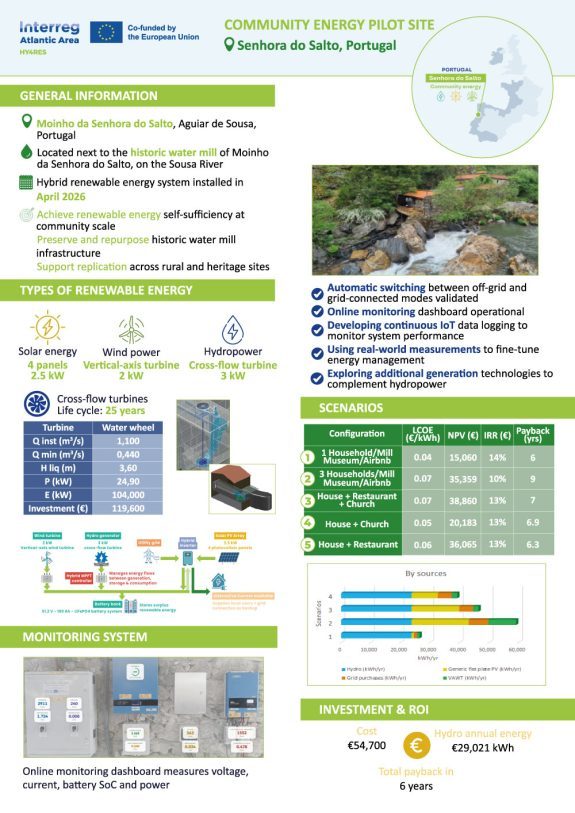
At Moinho da Senhora do Salto, in Paredes, northern Portugal, HY4RES demonstrates how a historic water mill can support local energy self-sufficiency through a hybrid renewable energy system.
The installation combines a 3 kW micro-hydropower turbine, 2.5 kW of solar PV and a 2-kW vertical-axis wind turbine, alongside battery storage and a hybrid inverter that allows both off-grid operation and grid backup. The hydropower system is the main energy source, with an estimated annual generation of 29,021 kWh.
With an investment of €54,700 and an estimated payback period of around six years, the pilot illustrates the potential of combining renewable technologies to meet local energy needs while preserving the site’s historical heritage.
Beyond energy production and financial performance, HY4RES assessed the wider environmental, economic, social and policy impacts of its hybrid renewable energy systems, including their direct and indirect effects and dependencies on nature.
The assessments highlighted different benefits and opportunities for improvement across the pilot sites. For example, the life cycle assessment of the port pilot showed that using a second-hand container could reduce the system’s environmental impact by around 35%. At the agricultural pilot, the assessment highlighted its educational value and its potential contribution to social transformation and local development.
Together, these assessments provide a broader understanding of the sustainability of hybrid renewable energy systems, beyond their energy and economic performance.
Alongside the development of technologies such as the fish-friendly Pump-as-Turbine and the intelligent energy management software, HY4RES identified potential markets for replicating its solutions across the four sectors addressed by the project.
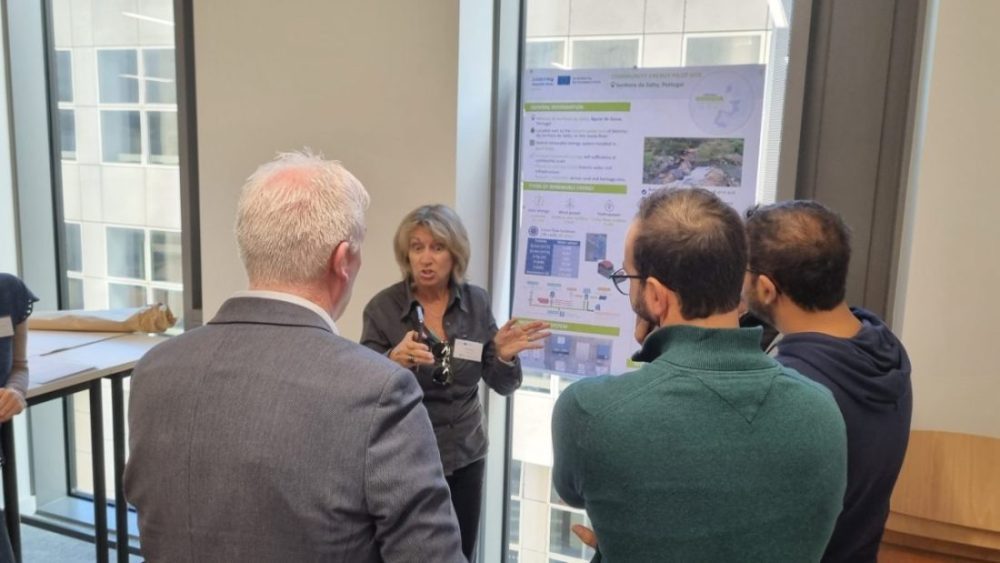
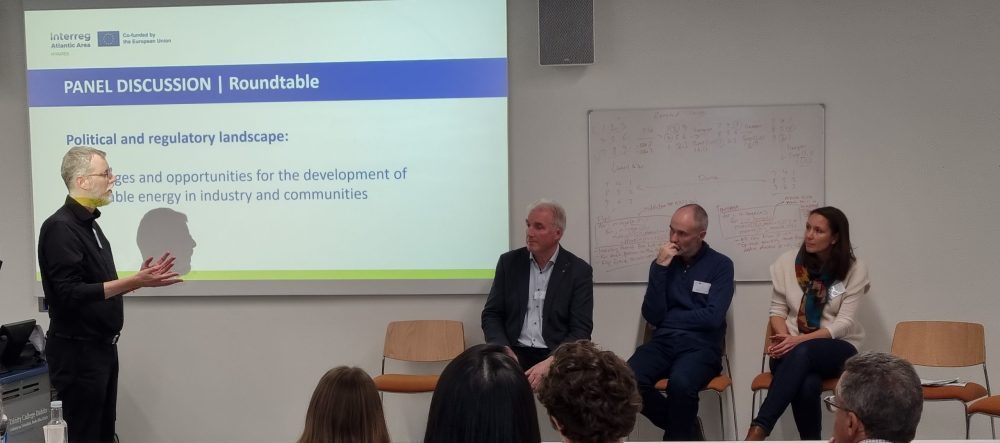
The project aso presented its policy brief: Renewable and hybrid energy frameworks in Europe, followed by a roundtable discussion on the challenges and opportunities for developing renewable energy in industry and communities.
The discussion brought together John Gallagher (Trinity College Dublin), HY4RES coordinator and manager of the Irish pilot site, Laure-Martin Poisson (Vertigo Lab) and Barry Caslin (Teagasc). Drawing on the Irish context, exchanges highlighted the importance of economic viability, supportive policies and incentives, grid capacity, and public acceptance. Participants also stressed the need to better match renewable energy production with local demand and to consider energy generation alongside other activities, such as food production.
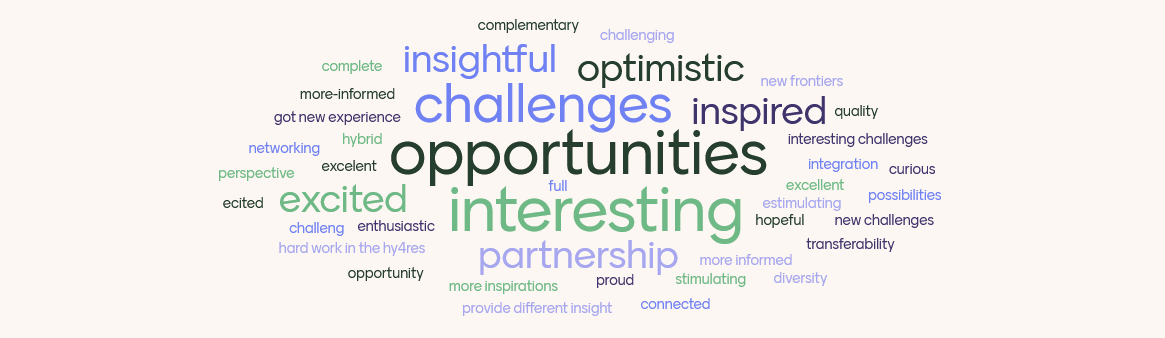
The participants were invited to share their views on the future of hybrid renewable energy systems and the conditions needed for their wider deployment. Responses highlighted the importance of energy storage and smart energy management, as well as the potential to adapt and replicate successful solutions across different sites and scales.
Participants also emphasised the need for supportive regulatory and financial frameworks, greater grid and storage capacity, and more opportunities for pilot demonstrations, collaboration, and training. Securing investment, addressing high upfront costs and simplifying planning and licensing procedures were identified as major challenges.
The participants highlighted the importance of involving local communities from an early stage, alongside public institutions, research organisations, and environmental NGOs. Overall, the responses pointed to the need for coordinated action, combining technological development with financial, regulatory, and social considerations.
Thanks to the support of the Interreg Atlantic Area programme co-financing HY4RES, a successful three years of transdisciplinary and applied research has permitted to make significant progress in the demonstration of hybrid renewable energy systems. All the reports and results from the project are available to the public on the website (https://hy4res.eu).
¹Application Programming Interface (API): set of rules and protocols that allows different software applications to communicate and share data with each other.
²Pump-as-turbine (PAT): hydraulic pump operated in reverse to act as a turbine. Flowing liquid drives the impeller in the opposite direction, converting fluid pressure and kinetic energy into mechanical shaft power or electricity.
³Computational Fluid Dynamics (CFD): computer-based method that uses numerical analysis and data structures to model, analyse and predict how liquids and gases flow and interact with surfaces. In the development of a fish-friendly turbine, CFD helps design blades and conduits that maximise electricity production while ensuring safe passage for fish.
⁴Centrifugal Screw Pump-as-Turbine (CSPAT): helical-centrifugal pump operated in reverse to generate electricity from water flow. Its unique single-vane impeller creates a wide, continuous spiral channel that makes it ideal for fish-friendly hydropower.
⁵Internet of Energy (IoE): digital network and smart infrastructure that connects energy generation, distribution, storage, load, and meters in real time to make power systems cleaner, more efficient, and more flexible.
Sign up to our newsletter!